Distributed Consistency: Beyond the CAP Theorem
Introduction — The Binary Trap
Ask any junior engineer about distributed databases, and they’ll mention the CAP Theorem. It’s the law of the land: pick two. But in production systems at FAANG scale, the CAP theorem is often more of a distraction than a guide.
The reality is that we rarely choose between Consistency and Availability in a vacuum. Modern engineering is about graceful degradation and latency trade-offs.
The CAP Limitation: Why Binary Isn't Reality
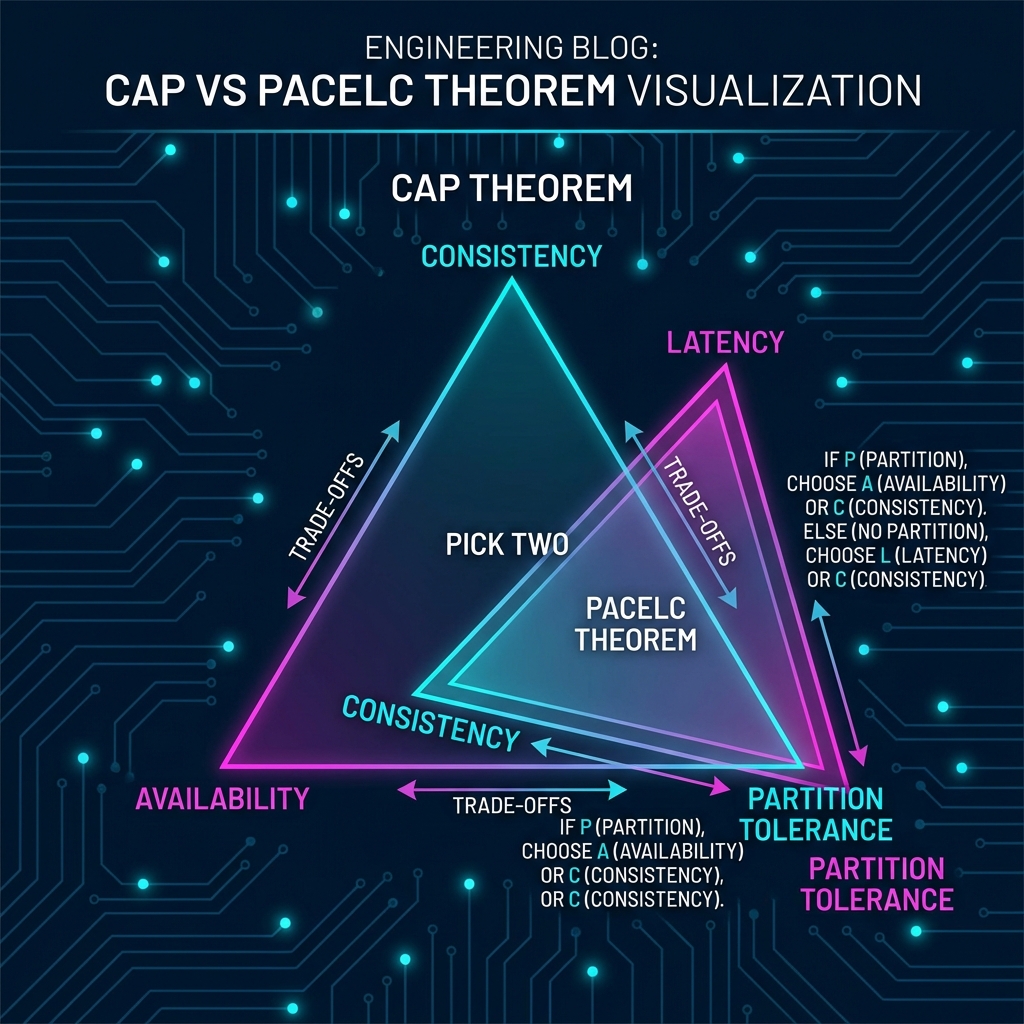
CAP (Consistency, Availability, Partition Tolerance) only describes behavior during a network partition. But network partitions are rare. Most of the time, the system is running "normally."
What happens when there is no partition? CAP doesn't tell you. This is why we need a better mental model.
Enter PACELC: The Senior Engineer’s Framework
PACELC extends CAP by looking at both states of a system:
- P (If there is a Partition): Choose between A (Availability) or C (Consistency).
- E (Else, during normal operation): Choose between L (Latency) or C (Consistency).
If you optimize for consistency, you pay for it in milliseconds. If you optimize for latency, you pay for it in "staleness."
Case Study: DynamoDB and the Quorum Model
Amazon's DynamoDB is the gold standard for high-scale consistency management. It uses a Quorum-based approach $(R+W > N)$, where:
- N: Total copies (replicas).
- W: Acknowledgments required for a successful write.
- R: Replicas checked for a successful read.
By tuning these numbers, you can toggle between Strong Consistency (high latency) and Eventual Consistency (low latency).
"In a global system, speed of light is your hardest constraint. Consistency is just a choice of how long you're willing to wait for the truth."
Designing for Truth vs. Speed
When designing a system, ask yourself: "Is a stale read fatal or just annoying?"
- Bank Ledger? Strong consistency is non-negotiable.
- Instagram Likes? Eventual consistency is perfect.
Summary Checklist for Distributed Architects:
- Identify your primary constraint (Cost, Latency, or Truth).
- Choose a default consistency level (Eventual by default).
- Implement "Read-Your-Writes" consistency for a better UX.
- Use versioning or vector clocks to resolve conflicts.
Conclusion
The evolution from CAP to PACELC represents our industry’s shift from theoretical constraints to operational reality. As a Staff Engineer, your job isn't to follow theorems—it's to navigate the trade-offs that keep the business alive while the light is still traveling between data centers.