From Demo to Dependence: The Moment a Product Becomes Unavoidable
Most Products Never Cross This Line
Almost every startup has a demo phase.
It looks like progress:
- Users sign up
- People say “this is cool”
- The product works in isolation
But very few products ever cross the invisible line where users stop trying them — and start depending on them.
That line is the difference between:
- A product people like
- And a product people can’t remove
Most startups die on the wrong side of it.
The Demo Trap
Demos are designed to impress:
- Zero setup
- Instant output
- No commitment required
They optimize for:
- First impressions
- Shareability
- Speed
And that’s exactly the problem.
A product that requires nothing from the user can never become critical to them.
Dependence requires friction:
- Configuration
- Trust
- Integration
- Responsibility
Without those, your product stays optional forever.
The Dependence Equation
A product becomes unavoidable when at least one of these is true:
-
It holds irreversible state
Data, history, records, or decisions that can’t simply be undone. -
It sits inside a critical workflow
Finance, operations, development, compliance, customer handling. -
It replaces human judgment at scale
Reviews, approvals, classification, monitoring. -
Its absence causes real pain
Costs rise, errors return, speed collapses.
Demos touch outputs.
Dependence touches consequences.
The Displacement Threshold
Every product exists in a market where the cost of staying (maintenance) is weighed against the cost of leaving (displacement).
For a demo, the displacement cost is near zero. You stop using it, and life returns to exactly how it was before. For a dependent product, displacement creates a vacuum.
Higher displacement cost comes from:
- Regulatory Gravity: Your tool is now the source of truth for compliance or audits.
- Inter-team Friction: Team A uses it to feed Team B. Removing it breaks the social contract of the organization.
- Embedded Logic: Your system doesn't just store data; it applies rules that the customer has forgotten how to execute manually.
If your "Value Prop" is just speed, you are easily replaced by a faster tool. If your "Value Prop" is displacement pain, you are a platform.
The Quiet Moment Dependence Begins
Dependence doesn’t start with applause.
It starts quietly:
- The first automated report that gets trusted
- The first decision made by the system
- The first audit trail no one wants to lose
- The first workflow that now assumes your product exists
Nothing looks exciting — but from this point on, removal hurts.
That’s the moment most founders miss.
Why Founders Avoid Building Dependence
Dependence is uncomfortable.
It:
- Takes longer
- Requires domain depth
- Forces accountability
- Makes failures visible
So founders unconsciously avoid it by:
- Staying “tool-like”
- Avoiding guarantees
- Letting users bear the blame
But real companies are not clever tools.
They are accountable systems.
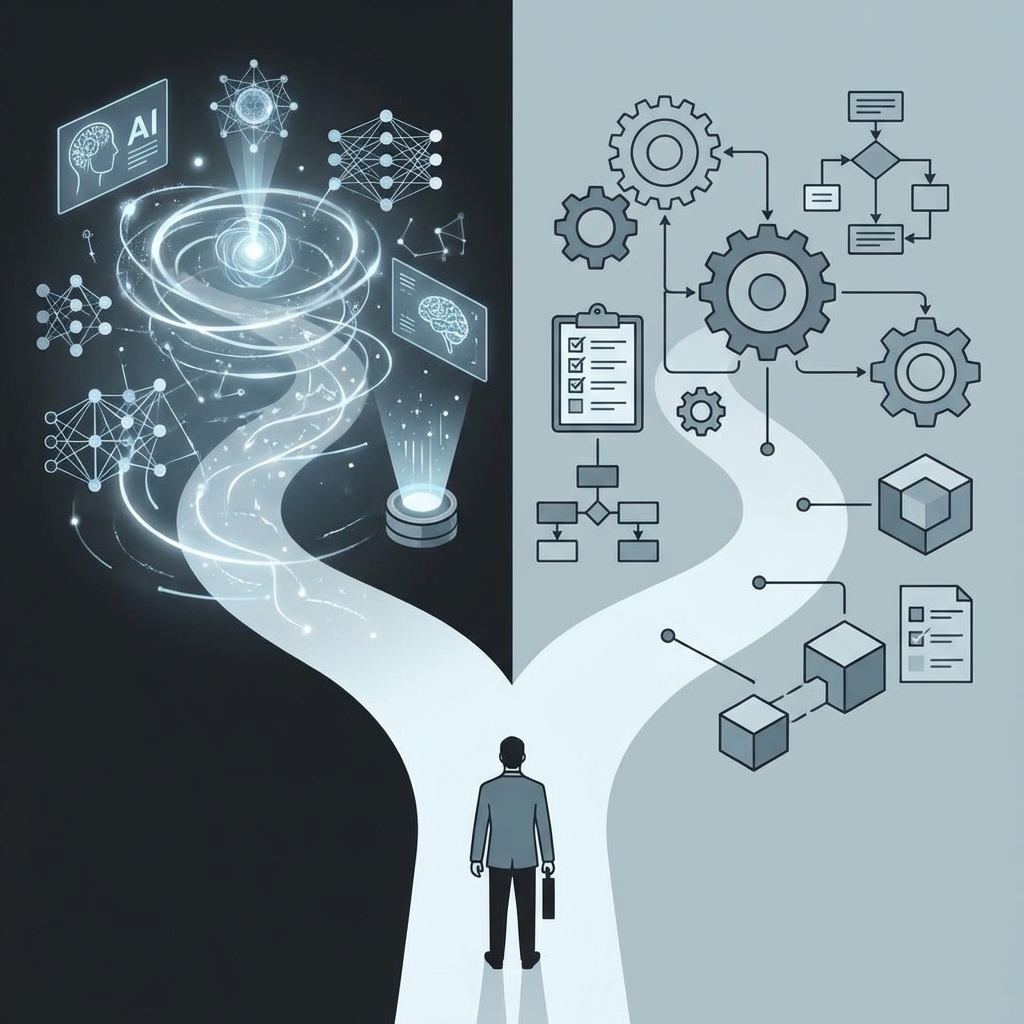
The Fork Every Product Reaches
Every startup eventually faces a choice.
Path 1: Optimize the Demo
- Better prompts
- More features
- Faster output
- Prettier UI
Feels productive.
Feels safe.
Leads to churn.
Path 2: Optimize for Dependence
- Deeper integration
- Fewer users, more usage
- Boring reliability
- Measurable outcomes
Feels slow.
Feels risky.
Builds real businesses.
A Simple Test for Founders
Ask yourself:
- What breaks if users stop using this?
- What irreversible state do we hold?
- What decision does our system make?
- Who gets blamed if it fails — us or the user?
If the answer is always “the user” — you’re still building a demo.
Designing for Friction (Counter-Intuitive Growth)
Modern SaaS teaches us to "remove all friction." This is great for top-of-funnel, but fatal for long-term retention if taken too far.
To build dependence, you must strategically introduce friction that leads to integration:
- Mandatory Integrations: Don't just offer an API; require a webhook to perform a core action.
- Customized Schemas: Force users to define how your data fits their world.
- Certification/Training: Make the user invest their own identity in mastering your system.
Friction is the tax users pay for stability. If they haven't paid it, they don't value the stay.
The "AI Wrapper" Survival Guide
In the current market, "AI Wrappers" are often criticized for having zero moat. They are the ultimate demos: easy to build, easy to try, and easy to churn from.
To bridge the gap from a GPT-wrapper to a dependent system:
- Move from Chat to CRUD: If your interface is just a text box, you are a tool. If your interface is a dashboard where users manage the results of the AI, you are a system.
- Own the Feedback Loop: Don't just show an output; allow the user to correct it and store that correction as a unique data asset.
- Automate the Boring Integration: Don't ask the user to copy-paste. Connect to their Slack, their Jira, or their DB. The moment you are "the thing that posts to Slack," you are hard to turn off.
The Founder's Choice
You can spend your time making the demo 10% more "wow," or you can spend it making the integration 10% more "un-removable."
The first gets you likes on X. The second gets you a trillion-dollar company.
Choose wisely.
Conclusion
The hardest moment in a startup is not shipping the first version.
It’s the moment you decide to stop impressing users and start being responsible for them.
That’s when a product stops being nice to have — and becomes unavoidable.