Most AI Startups Are Replaceable. Here’s the Pattern
Everyone Is Building AI. Most Won’t Last.
In the last two years, AI startups exploded.
New tools every week.
Demos that look magical.
Founders shipping faster than ever.
And yet — most of these startups are quietly replaceable.
Not because they use APIs.
Not because they don’t train their own models.
But because they misunderstand where value actually lives.
The term “AI wrapper” gets thrown around as an insult.
But it’s the wrong diagnosis.
The Real Pattern Behind Failed AI Startups
Most failed AI startups share three traits:
- Their core value is a model capability
- Users can switch tools instantly
- Nothing breaks when the product disappears
If your product’s pitch is essentially:
“Look what GPT can do now”
You’re on a clock you don’t control.
Models improve.
Platforms copy.
Your differentiation evaporates.
Failure Stories: When “Wrapper” Meant Replaceable
AI PDF Chat Tools
The idea was compelling: chat with your documents.
But the reality was harsh:
- No deep workflow ownership
- No proprietary data advantage
- No lock-in beyond convenience
Once ChatGPT, Microsoft Copilot, and Adobe shipped native document chat, these products lost their reason to exist.
Lesson:
If a platform can ship your core feature as a checkbox, you never owned the problem.
AI Copywriting Startups
The 2023–2024 wave was massive:
- Blog generators
- SEO writers
- Ad copy tools
They grew fast — and churned faster.
Why?
- Output didn’t equal outcome
- Users didn’t need text, they needed traffic and revenue
- Content became a baseline feature everywhere
Lesson:
If users don’t lose money or time without you, you’re optional.
AI Resume Builders
Most were one-time-use tools:
- Generate resume
- Download PDF
- Never return
They didn’t own:
- Hiring pipelines
- Recruiter feedback
- Interview outcomes
Lesson:
One-time value is not a business.
The Quiet Winners Don’t Look Impressive at First
Now let’s look at startups that do survive — and why they’re often misunderstood.
Harvey AI (Legal)
From the outside, it looks like:
“GPT for lawyers”
In reality:
- Embedded in law firm workflows
- Trained on firm-specific context
- Handles compliance, research, and due diligence
Once adopted, switching is painful.
Why it survives:
It owns workflow, trust, and historical context — not just generation.
Cursor (AI Code Editor)
At first glance:
“Just GPT inside an editor”
But Cursor:
- Lives inside daily developer work
- Understands entire codebases
- Learns from edits, refactors, and mistakes
If Cursor disappeared tomorrow, developers wouldn’t miss autocomplete — they’d miss thinking leverage.
Why it survives:
Habit + irreversibility.
Glean (Enterprise Search)
Surface-level view:
“AI search for company docs”
Reality:
- Cross-tool organizational memory
- Permissions, context, and history
- Becomes the company’s knowledge backbone
Why it survives:
Search isn’t the product.
Organizational memory is.
Where AI Value Actually Compounds
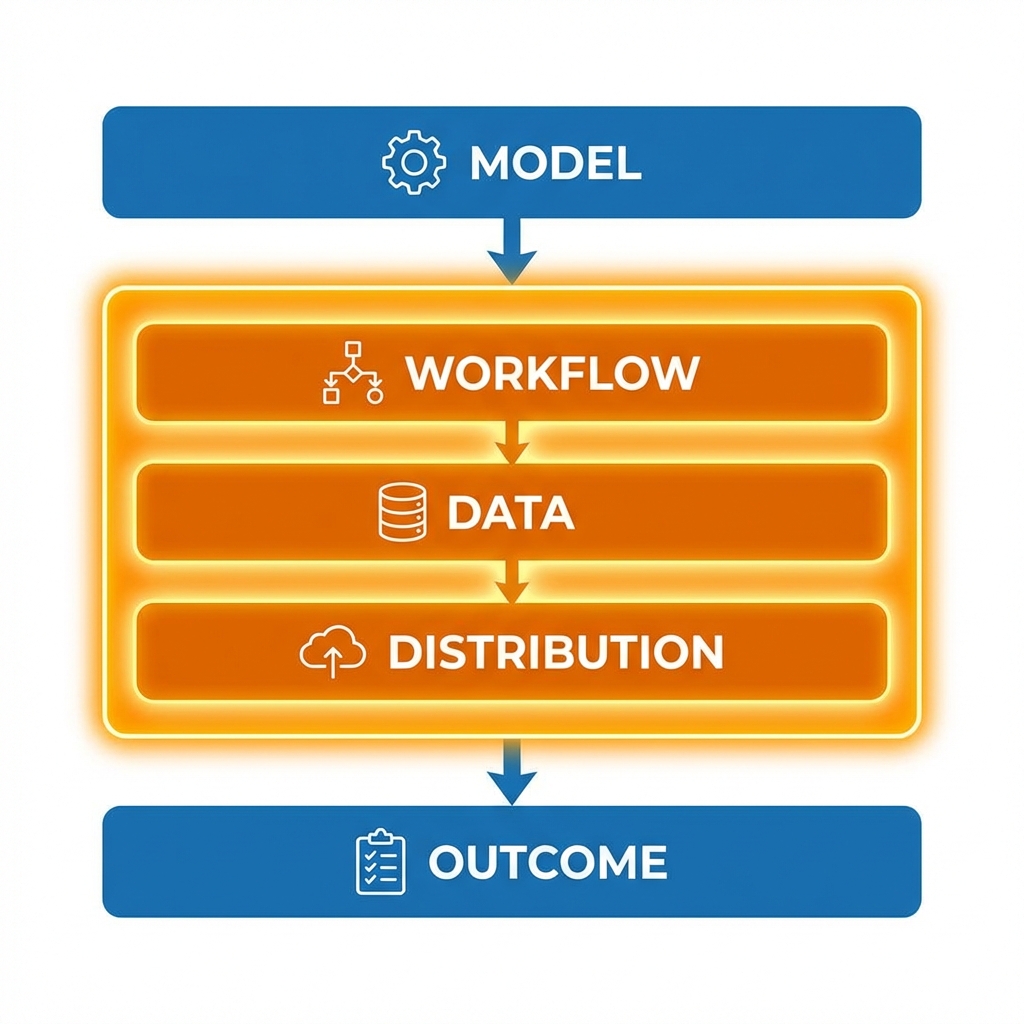
Every AI product sits on layers:
- Model – commoditized fast
- Workflow – where pain lives
- Data – where moats begin
- Distribution – trust and habit
- Outcome – money saved, risk reduced, time reclaimed
Most replaceable startups stop at model + UI.
Real products dominate at least two layers above that.
What a “Real AI Product” Means in 2026
A real AI product is not defined by:
- Fine-tuning
- Custom models
- Prompt engineering
It is defined by irreversibility.
If users leave and nothing breaks — you built a tool.
If leaving hurts — you built a system.
The Brutal Test Every Founder Should Apply
Ask one question:
If GPT-6 launches tomorrow, what breaks?
- ❌ “Our main feature” → replaceable
- ✅ “Our margins get better” → durable
That’s the pattern.
Final Thought
AI is not the product.
AI is leverage.
The real product is:
- The workflow you replace
- The decision you automate
- The outcome you guarantee
Everything else is just a demo.