Introduction — Why Big O Basics Fail in Senior Interviews
Every candidate can say that a nested loop is O(n²). Senior interviews go one level deeper. The interviewer asks what happens to the recursion stack, whether that substring call is free, and why your while inside a for is not quadratic.
The gap is rarely theory. It is hidden cost: a copy you did not see, a stack frame you did not count, or a second input variable you folded into n. Those are the points where a correct answer turns into a hire or a no-hire.
This guide walks through 13 patterns in four groups. Every snippet is available in Java, Python, and C++, and the language differences that change the answer are called out in the reveal blocks.
Mental model: Complexity is not a property of the algorithm in the abstract. It is a property of the algorithm plus the operations your language hides inside each line.
How to use this guide
Above each code block you will find language tabs. Pick Java, Python, or C++ and the snippet switches. Your choice is remembered for the rest of the page.
Each pattern ends with a collapsed block. Read the code, commit to an answer for time and space, then open the block to check yourself.
Click to Reveal Time and Space Complexity
- Time Complexity:
O(...)with a one-line derivation. - Space Complexity:
O(...)split into stack and auxiliary allocation. - Language Nuance: the Java, Python, or C++ trap, where one exists.
Loops and Multiple Input Variables
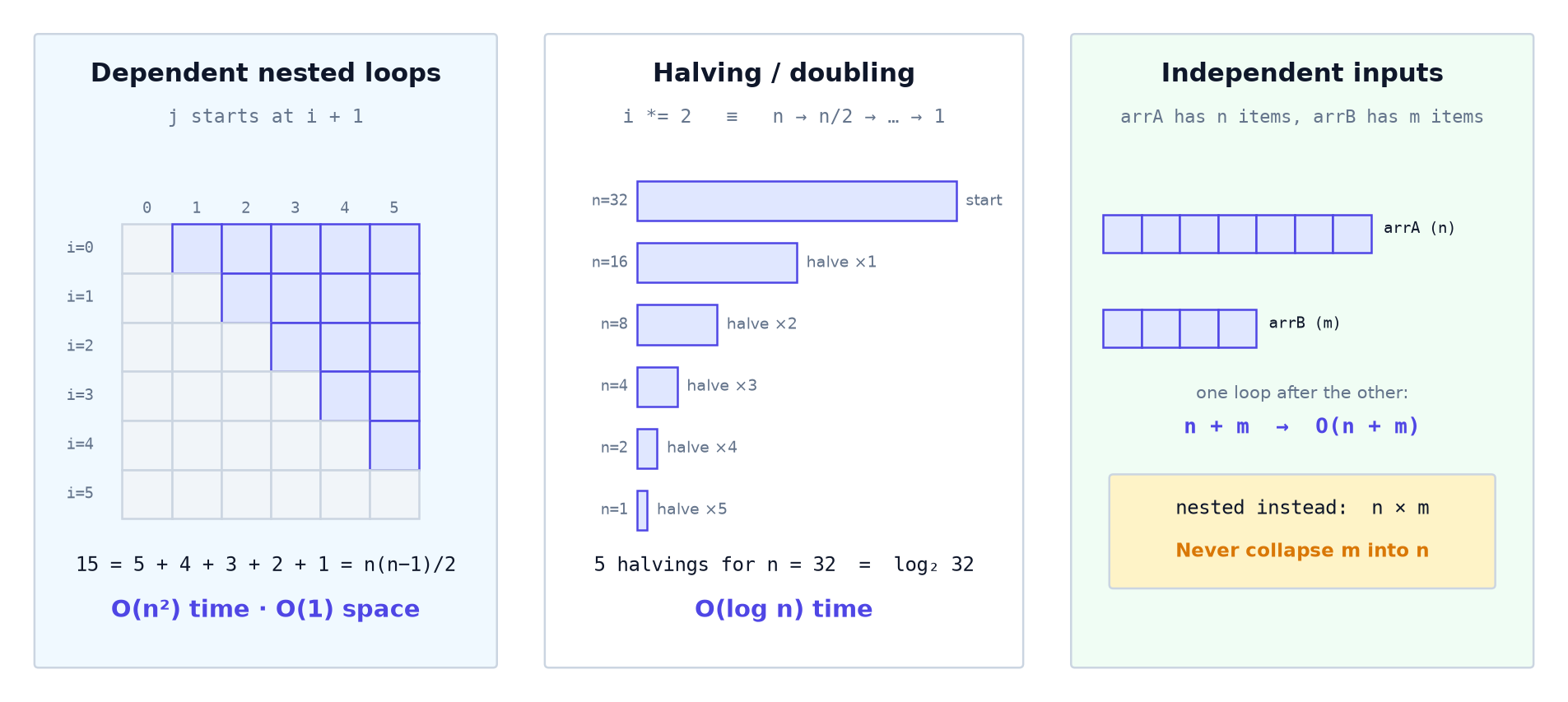
Most complexity mistakes in this group come from counting loops instead of counting iterations. The diagram below puts the three shapes side by side.
Pattern 1: Dependent Nested Loops
When the inner loop starts from the outer index, the work shrinks on every pass. This is the triangular pattern, and it still sums to a quadratic.
for (int i = 0; i < n; i++) {
    for (int j = i + 1; j < n; j++) {
        // work
    }
}
for i in range(n):
for j in range(i + 1, n):
pass # workfor (int i = 0; i < n; i++) {
for (int j = i + 1; j < n; j++) {
// work
}
}What is the time and space complexity?
Click to Reveal Time and Space Complexity
- Time Complexity:
O(n²). The inner loop runs(n-1) + (n-2) + ... + 1 = n(n-1)/2times. Half ofn²is stilln²once constants are dropped. - Space Complexity:
O(1). Only the two loop counters are allocated. - Language Nuance: none. All three languages have the identical bound.
Pattern 2: Halving and Doubling Loops
A loop that multiplies or divides its counter by a constant runs a logarithmic number of times, not a linear one.
for (int i = 1; i < n; i *= 2) {
    // work
}
i = 1
while i < n:
# work
i *= 2for (int i = 1; i < n; i *= 2) {
// work
}Click to Reveal Time and Space Complexity
- Time Complexity:
O(log n). The counter takes the values1, 2, 4, ..., n, which islog2(n)steps. - Space Complexity:
O(1). - Wrapping an
O(n)loop: the total becomesO(n log n). - The senior trap: if the inner loop is bounded by
iinstead ofn(for (int j = 0; j < i; j++)), the work is1 + 2 + 4 + ... + n, which sums toO(n), notO(n log n).
Pattern 3: Multiple Independent Inputs
When a function receives two collections, they are two different variables. Never rename m to n to make the answer look tidy.
for (int x : arrA) { /* work */ }   // arrA has n items
for (int y : arrB) { /* work */ }   // arrB has m items
for x in arr_a: # arr_a has n items
pass # work
for y in arr_b: # arr_b has m items
pass # workfor (int x : arrA) { /* work */ } // arrA has n items
for (int y : arrB) { /* work */ } // arrB has m itemsClick to Reveal Time and Space Complexity
- Time Complexity:
O(n + m). Sequential loops add. Nesting them would multiply toO(n * m). - Space Complexity:
O(1). - Language Nuance: none, but the rule matters most on graphs (
VandE) and grids (RandC), where collapsing variables is a common mistake.
Amortized Analysis and Hidden Language Costs
This is the group that separates memorized answers from real understanding. A single line can hide a copy, and a single loop can look quadratic while being linear.
Pattern 4: Sliding Window and Monotonic Stack
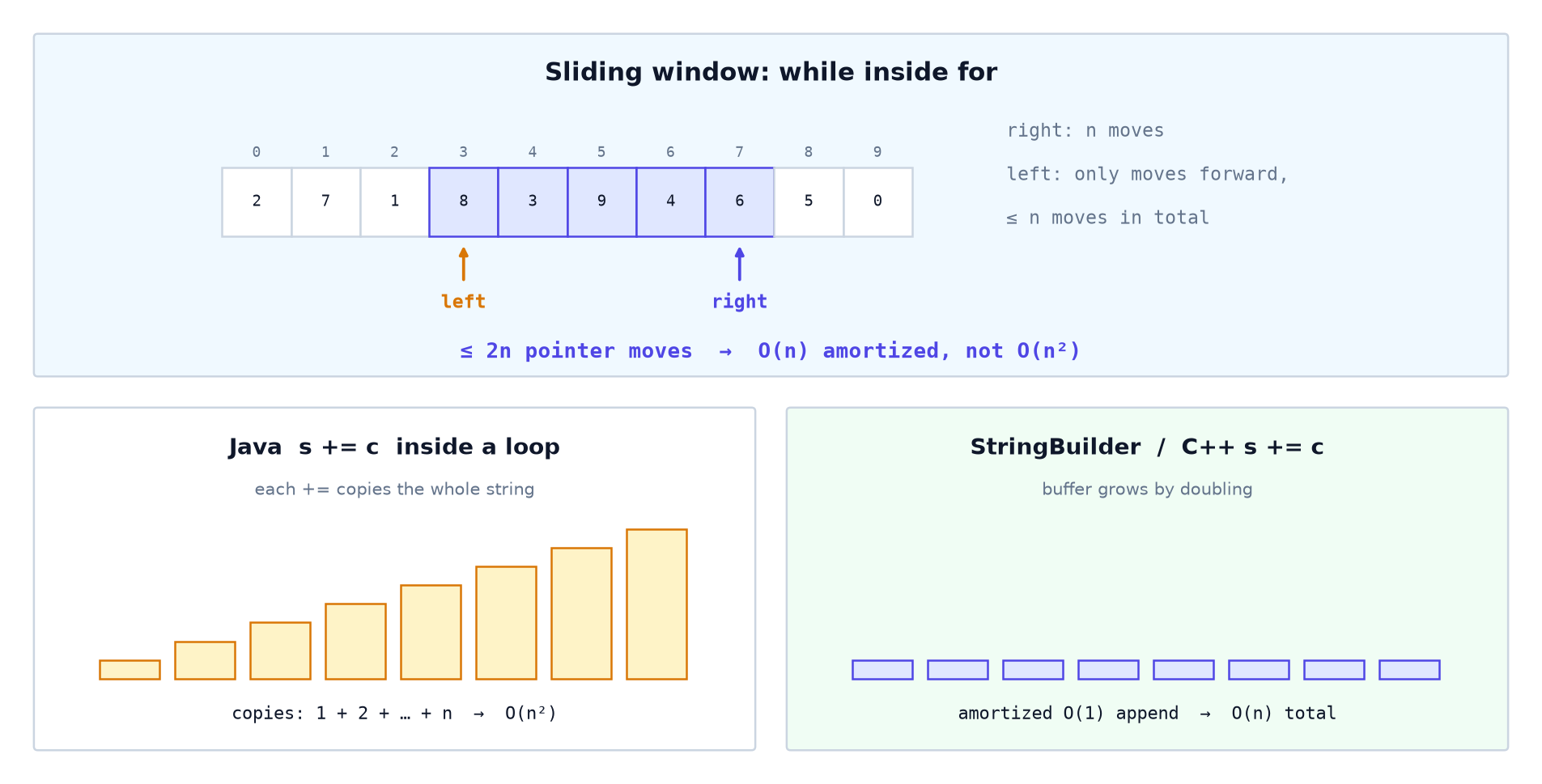
A while inside a for does not automatically mean O(n²). What matters is the total movement of the inner pointer across the entire run.
int left = 0;
for (int right = 0; right < n; right++) {
    while (conditionInvalid(left, right)) {
        left++;
    }
}
left = 0
for right in range(n):
while condition_invalid(left, right):
left += 1int left = 0;
for (int right = 0; right < n; right++) {
while (conditionInvalid(left, right)) {
left++;
}
}Click to Reveal Time and Space Complexity
- Time Complexity:
O(n)amortized.rightmovesntimes andleftonly moves forward, so it moves at mostntimes in total: at most2npointer moves. - Space Complexity:
O(1)for the window itself. A monotonic stack variant usesO(n)in the worst case, since every element can be pushed once. - Language Nuance: none. The argument is about pointer movement, not syntax.
Pattern 5: String Concatenation Traps
Strings are immutable in Java and Python, so a naive += can allocate a new string and copy the old content on every iteration. The costs 1 + 2 + ... + n add up to a quadratic.
// Bad: O(n^2), a new String of size 1, 2, ..., n each time
String res = "";
for (int i = 0; i < n; i++) {
    res += "a";
}

// Good: O(n) amortized
StringBuilder sb = new StringBuilder();
for (int i = 0; i < n; i++) {
    sb.append('a');
}
# Risky: O(n^2) in general (CPython may optimize it, but do not rely on that)
res = ""
for _ in range(n):
res += "a"
# Good: O(n), build a list and join once
parts = []
for _ in range(n):
parts.append("a")
res = "".join(parts)// Bad: s = s + 'a' builds a temporary string every time, O(n) each
std::string bad;
for (int i = 0; i < n; i++) {
bad = bad + 'a';
}
// Good: append in place, amortized O(1) each
std::string s;
for (int i = 0; i < n; i++) {
s += 'a';
}Click to Reveal Time and Space Complexity
- Time Complexity:
O(n²)for the bad versions.O(n)withStringBuilder, a list plus"".join(), or C++s += c. - Space Complexity:
O(n)for the final string. The bad version also createsO(n²)total garbage over its lifetime. - Language Nuance: CPython sometimes optimizes
str +=in place when nothing else references the string. That is an implementation detail, not a guarantee, so interviewers expect"".join(). In C++,s += cappends in place buts = s + cdoes not.
Pattern 6: Sorting Strings and Objects
Sorting numbers costs O(n log n) comparisons because each comparison is O(1). Strings break that assumption.
// n words, each at most k characters long
Arrays.sort(words);
# n words, each at most k characters long
words.sort()// n words, each at most k characters long
std::sort(words.begin(), words.end());Click to Reveal Time and Space Complexity
- Time Complexity:
O(n * k * log n). There areO(n log n)comparisons and each compares up tokcharacters. - Space Complexity:
O(n)auxiliary in the worst case. Java sorts objects with TimSort, which uses a merge buffer. - Language Nuance: Python
list.sort()is also TimSort withO(n)worst-case space. C++std::sortis introsort withO(log n)stack space, but it is not stable; usestd::stable_sortwhen order of equal keys matters.
Pattern 7: Substring and Slice Copies
Taking a piece of a string looks like pointer arithmetic. In most languages it is a copy.
String sub = s.substring(l, r); // Java 7u6 and later: copiessub = s[l:r] # slice: copiesstd::string sub = s.substr(l, r - l); // copies
std::string_view view(s.data() + l, r - l); // C++17 view, no copyClick to Reveal Time and Space Complexity
- Time Complexity:
O(k)wherek = r - l, notO(1). Inside a loop overnpositions, this can turn a linear scan intoO(n * k). - Space Complexity:
O(k)for the new string. - Language Nuance: Java before 7u6 shared the backing array, so old advice that substring is
O(1)is outdated. Python slices copy. C++std::string_viewis the only commonO(1)option, and it is only safe while the original string outlives the view.
Recursion, Trees, Graphs, and Dynamic Programming
Recursion hides space in the call stack. If you only count the arrays you declared, you will undercount every recursive solution.
Pattern 8: Recursion Call Stack Space in Trees
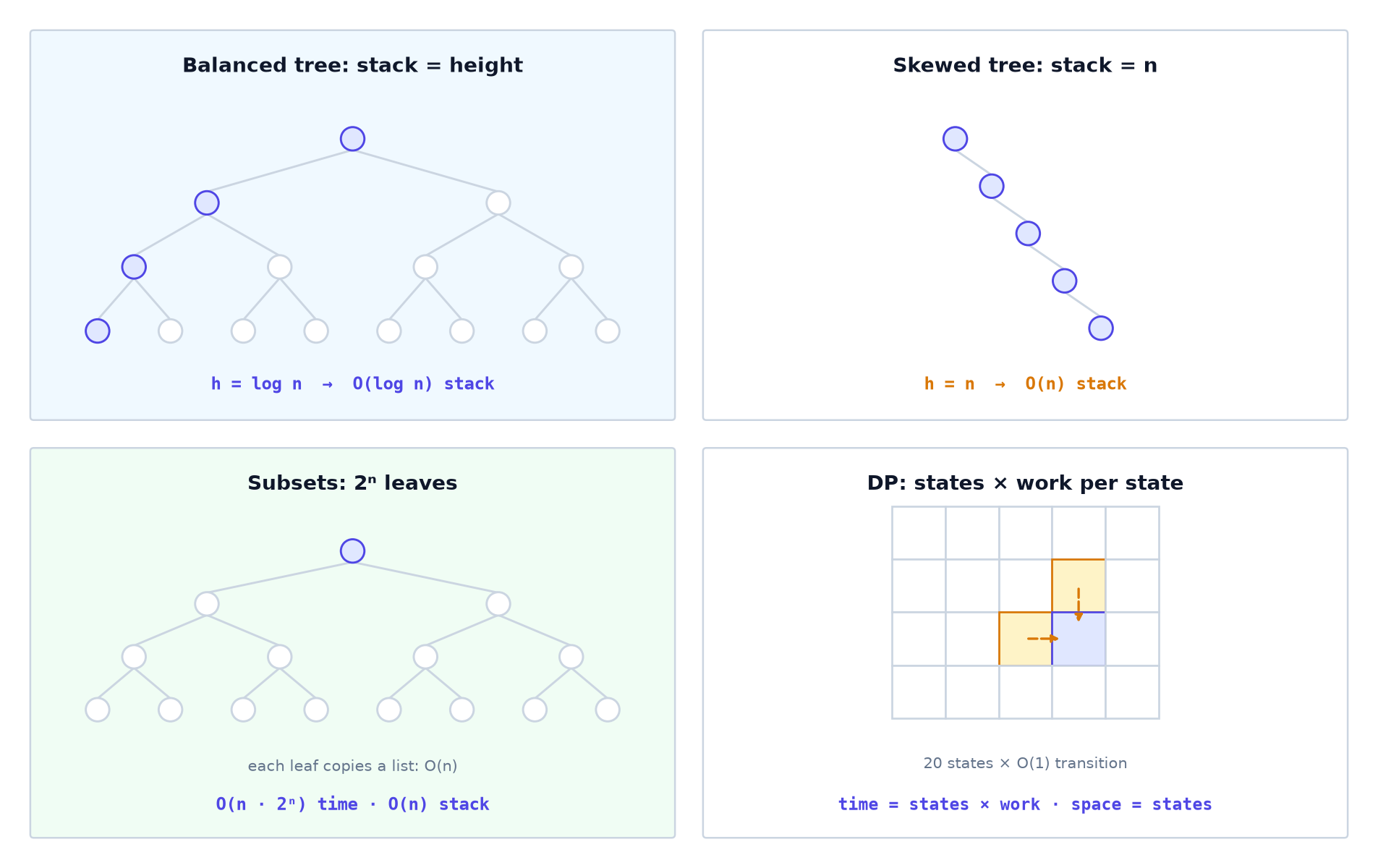
The stack depth equals the tree's height, not the number of nodes.
int maxDepth(TreeNode root) {
    if (root == null) return 0;
    return 1 + Math.max(maxDepth(root.left), maxDepth(root.right));
}
def max_depth(root):
if root is None:
return 0
return 1 + max(max_depth(root.left), max_depth(root.right))int maxDepth(TreeNode* root) {
if (root == nullptr) return 0;
return 1 + std::max(maxDepth(root->left), maxDepth(root->right));
}Click to Reveal Time and Space Complexity
- Time Complexity:
O(n). Every node is visited exactly once. - Space Complexity:
O(h), wherehis the height. That isO(log n)for a balanced tree andO(n)for a skewed one. - Language Nuance: Python's default recursion limit is about 1000 frames, so a skewed tree of 10,000 nodes raises
RecursionErrorbefore the complexity matters. Java throwsStackOverflowErrorat a similar scale.
Pattern 9: Branching Recursion and Backtracking
Count the leaves, then count what each leaf costs. The subsets problem has 2^n leaves, and every leaf copies a list.
void subsets(int idx, List<Integer> cur, List<List<Integer>> ans, int[] nums) {
    if (idx == nums.length) {
        ans.add(new ArrayList<>(cur));   // O(n) copy at each leaf
        return;
    }
    cur.add(nums[idx]);
    subsets(idx + 1, cur, ans, nums);
    cur.remove(cur.size() - 1);
    subsets(idx + 1, cur, ans, nums);
}
def subsets(idx, cur, ans, nums):
if idx == len(nums):
ans.append(cur[:]) # O(n) copy at each leaf
return
cur.append(nums[idx])
subsets(idx + 1, cur, ans, nums)
cur.pop()
subsets(idx + 1, cur, ans, nums)void subsets(int idx, vector<int>& cur, vector<vector<int>>& ans, const vector<int>& nums) {
if (idx == (int)nums.size()) {
ans.push_back(cur); // O(n) copy at each leaf
return;
}
cur.push_back(nums[idx]);
subsets(idx + 1, cur, ans, nums);
cur.pop_back();
subsets(idx + 1, cur, ans, nums);
}Click to Reveal Time and Space Complexity
- Time Complexity:
O(n * 2^n). There are2^nleaves and each performs anO(n)copy. SayingO(2^n)forgets the copy. - Space Complexity:
O(n)auxiliary for the recursion stack and thecurlist, excluding the output. The output itself holdsO(n * 2^n)values. - Language Nuance: none. Python
cur[:]and C++push_back(cur)copy in exactly the same way as Java'snew ArrayList<>(cur).
Pattern 10: Memoization and the DP Formula
Every dynamic programming answer reduces to one sentence: states times work per state. This example is the longest common subsequence of two strings.
// a has n chars, b has m chars; O(1) transition per cell
int[][] dp = new int[n + 1][m + 1];
for (int i = 1; i <= n; i++) {
    for (int j = 1; j <= m; j++) {
        if (a.charAt(i - 1) == b.charAt(j - 1)) {
            dp[i][j] = dp[i - 1][j - 1] + 1;
        } else {
            dp[i][j] = Math.max(dp[i - 1][j], dp[i][j - 1]);
        }
    }
}
# a has n chars, b has m chars; O(1) transition per cell
dp = [[0] * (m + 1) for _ in range(n + 1)]
for i in range(1, n + 1):
for j in range(1, m + 1):
if a[i - 1] == b[j - 1]:
dp[i][j] = dp[i - 1][j - 1] + 1
else:
dp[i][j] = max(dp[i - 1][j], dp[i][j - 1])// a has n chars, b has m chars; O(1) transition per cell
vector<vector<int>> dp(n + 1, vector<int>(m + 1, 0));
for (int i = 1; i <= n; i++) {
for (int j = 1; j <= m; j++) {
if (a[i - 1] == b[j - 1]) {
dp[i][j] = dp[i - 1][j - 1] + 1;
} else {
dp[i][j] = max(dp[i - 1][j], dp[i][j - 1]);
}
}
}Click to Reveal Time and Space Complexity
- Time Complexity:
Time = (number of states) * (work per state), hereO(n * m) * O(1) = O(n * m). - Space Complexity:
Space = (number of states) + stack, hereO(n * m). Because each row depends only on the previous row, it can be reduced toO(m). - Language Nuance: top-down memoization adds a recursion stack of depth up to the longest dependency chain. In Python that can hit the recursion limit, which is why bottom-up tables are safer.
Pattern 11: Graph and Matrix Traversal
A visited set turns an exponential search into a linear one, because each vertex is processed once.
// BFS over an adjacency list with V vertices
boolean[] visited = new boolean[V];
Deque<Integer> queue = new ArrayDeque<>();
queue.add(start);
visited[start] = true;
while (!queue.isEmpty()) {
    int u = queue.poll();
    for (int v : adj.get(u)) {
        if (!visited[v]) {
            visited[v] = true;
            queue.add(v);
        }
    }
}
# BFS over an adjacency list with V vertices
from collections import deque
visited = [False] * V
queue = deque([start])
visited[start] = True
while queue:
u = queue.popleft()
for v in adj[u]:
if not visited[v]:
visited[v] = True
queue.append(v)// BFS over an adjacency list with V vertices
vector<bool> visited(V, false);
queue<int> q;
q.push(start);
visited[start] = true;
while (!q.empty()) {
int u = q.front();
q.pop();
for (int v : adj[u]) {
if (!visited[v]) {
visited[v] = true;
q.push(v);
}
}
}Click to Reveal Time and Space Complexity
- Time Complexity:
O(V + E). Each vertex is enqueued once and each edge is inspected once (twice if undirected). For anR x Cgrid with 4-directional moves this becomesO(R * C), since each cell has at most 4 edges. - Space Complexity:
O(V)for the visited structure plus the queue or recursion stack. For grids,O(R * C). - Language Nuance: recursive DFS on a grid can reach depth
R * C, which overflows the stack in Python and Java for large inputs. Prefer an explicit stack or BFS there.
Data Structures and Space Accounting
The last group is about what you choose to count, and what you say out loud before the interviewer has to ask.
Pattern 12: Heap Top-K
Keeping a heap capped at k is cheaper than sorting everything when k is much smaller than n.
PriorityQueue<Integer> minHeap = new PriorityQueue<>();
for (int num : nums) {
    minHeap.offer(num);
    if (minHeap.size() > k) {
        minHeap.poll();
    }
}
import heapq
heap = []
for num in nums:
heapq.heappush(heap, num)
if len(heap) > k:
heapq.heappop(heap)std::priority_queue<int, std::vector<int>, std::greater<int>> minHeap;
for (int num : nums) {
minHeap.push(num);
if ((int)minHeap.size() > k) minHeap.pop();
}Click to Reveal Time and Space Complexity
- Time Complexity:
O(n log k). Each of thenelements costs one push and at most one pop on a heap of sizek. - Space Complexity:
O(k). Compare this withO(n log n)time for a full sort. - Language Nuance: Java
PriorityQueueand Pythonheapqare min-heaps by default. C++std::priority_queueis a max-heap by default, so a top-K-largest solution needsstd::greater<int>to keep the smallest of the K at the top.
Pattern 13: Auxiliary Space vs Input vs Output Space
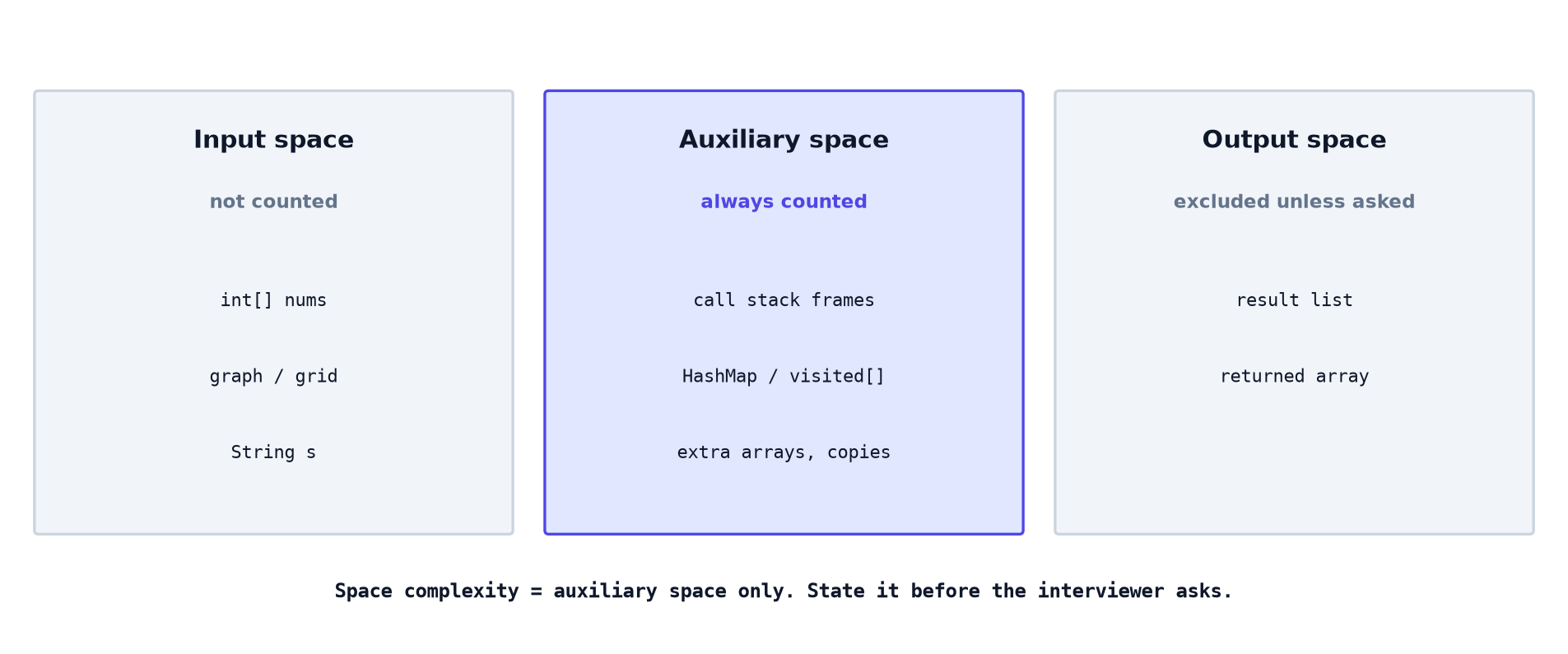
Space questions are usually about auxiliary space, the extra memory your algorithm allocates beyond the input.
- Input space is excluded. You were given it.
- Auxiliary space is always counted: extra data structures and the recursion call stack.
- Output space is usually excluded, unless the interviewer asks for total space.
Click to Reveal Time and Space Complexity
- Reversing an array in place:
O(1)auxiliary space. - Returning a reversed copy:
O(n)auxiliary if the copy is a working buffer, orO(n)output if it is the answer. Say which one you mean. - Subsets (Pattern 9):
O(n)auxiliary, even though the output isO(n * 2^n). - Rule to state out loud: "I am counting auxiliary space, including the call stack, and excluding the input and the returned result."
Language Traps at a Glance
| Situation | Java | Python | C++ |
|---|---|---|---|
| String built in a loop | += is O(n²); use StringBuilder |
Use a list and "".join() |
s += c is fine; s = s + c is not |
| Substring or slice | substring copies |
slice copies | substr copies; string_view does not |
| Sorting objects | TimSort, O(n) space, stable |
TimSort, O(n) space, stable |
introsort, O(log n) space, not stable |
| Deep recursion | StackOverflowError |
RecursionError near 1000 frames |
undefined behavior on stack overflow |
| Default heap | min-heap | min-heap (heapq) |
max-heap |
Conclusion
Complexity analysis in a senior interview is a short, repeatable routine. Run these five checks before you state a bound out loud:
- Name every input variable. If there are two collections, there are two letters.
- Count total work, not loop nesting. Ask how many times the inner body runs across the entire execution.
- Look for hidden copies. String concatenation, substring, slices, and
new ArrayList<>(cur)all costO(k). - Count the call stack. Recursion depth is auxiliary space.
- Say what you are excluding. State that input and output space are not counted.
Practice the 13 patterns until each answer comes out as a single sentence. The fastest way to get there is to cover the reveal block, say the bound aloud, and only then check.